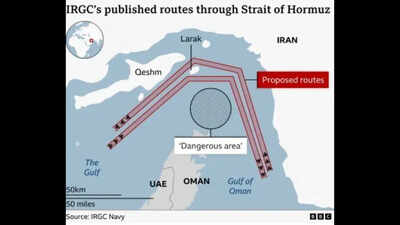
Introduction: Nature of the Emerging BlockadeThe emerging U.S. decision in April 2026 to impose a selective naval blockade targeting Iranian maritime traffic marks a significant escalation in maritime coercion strategy. Unlike a classical “total closure,” Washington’s approach reflects a limited blockade doctrine focused on economic strangulation rather than outright denial of global shipping. The intent is not to shut the Strait of Hormuz entirely, but to interdict vessels linked to Iran while allowing neutral shipping to continue. This distinction reflects a transition from traditional kinetic blockade warfare to a hybrid legal-economic enforcement regime. The narrow geography of the Strait, roughly 30 kilometres at its tightest navigable point, creates a compressed battlespace in which all actors operate within each other’s missile, drone, and surveillance envelopes simultaneously, fundamentally shaping operational dynamics.
Operational Design: Layered U.S. Tactical PlanThe U.S. tactical plan for enforcing such a blockade would rely on a layered maritime interdiction architecture designed to integrate surveillance, interception, escort, and strike capabilities into a coherent operational framework.
The outermost layer would consist of a surveillance and identification zone extending into the Gulf of Oman, where maritime patrol aircraft such as the P-8 Poseidon, supported by unmanned aerial systems and satellite-based tracking, would establish a comprehensive recognised maritime picture. The objective would be early identification of vessels suspected of trading with Iran, allowing sufficient reaction time for interception further west.
Iran’s Chokehold On Hormuz: How Prepared Is India To Tackle Naval Mine Threat?
Moving inward, the interception and boarding layer would be positioned along the approaches to the Strait. U.S. Navy destroyers, littoral combat ships, and Coast Guard boarding teams would conduct visit, board, search, and seizure operations. The emphasis would be on coercive compliance rather than immediate destruction, reflecting both legal considerations and escalation control. Vessels identified as violating the blockade would be diverted, detained, or escorted away from Iranian ports, making this phase the operational core of enforcement.
Within the Strait itself, the U.S. would likely revive a convoy escort model reminiscent of the late Cold War Tanker War. Naval surface combatants equipped with Aegis combat systems would provide layered air and missile defence for escorted commercial shipping. These escorts would have to contend with persistent threats from drones, anti-ship missiles, and fast attack craft operating from Iran’s coastline. The confined geography significantly increases vulnerability, as escort vessels cannot manoeuvre freely and remain within range of Iranian shore-based systems at all times.
Beyond the immediate maritime space, a deeper strike and suppression layer would be essential to sustain the blockade. Carrier strike groups, supported by submarines and long-range bombers operating from regional bases such as Diego Garcia, would target Iranian coastal missile batteries, drone launch sites, naval infrastructure, and mining capabilities. The underlying logic is that securing maritime transit in Hormuz is impossible without degrading the land-based systems that threaten it, thereby transforming the blockade into a joint, multi-domain campaign extending deep into Iranian territory.
Mine Warfare and Legal DimensionsA critical but often underappreciated component of this plan is mine countermeasure operations. Iran has historically relied on naval mines as a cost-effective asymmetric weapon, and even limited mining activity can disrupt shipping lanes disproportionately. The United States would deploy specialised mine countermeasure vessels, helicopters, and unmanned underwater systems to detect and neutralise mines. However, the capacity for sustained mine-clearing operations remains limited, posing a structural vulnerability in any prolonged blockade scenario.
The legal dimension of the blockade is equally important. The United States would likely frame the operation within international law, issuing formal notices to mariners and leveraging the global insurance and shipping ecosystem to enforce compliance. This “lawfare” component transforms the blockade into a hybrid instrument, where financial and legal pressures amplify the effects of military action. In practice, shipping companies may avoid Iranian routes not because they are physically blocked, but because insurance becomes prohibitively expensive or unavailable.
Force Levels and Deployment RequirementsA credible blockade would require a substantial and sustained deployment. At least one to two carrier strike groups would be necessary to provide air dominance and strike capability, supplemented by multiple amphibious ready groups for flexibility in crisis response. A surface fleet of approximately fifteen to twenty-five combatant vessels would be required to maintain continuous presence across the operational layers, while several attack submarines would provide stealth, deterrence, and strike options. Air assets numbering over a hundred aircraft would be needed to sustain surveillance, interception, and strike operations. Mine warfare units, though fewer in number, would be indispensable for keeping sea lanes open. Crucially, the absence of robust coalition participation would strain U.S. capabilities and reduce both operational depth and political legitimacy.
Operational Constraints in the Hormuz BattlespaceOperational constraints are severe and inherent to the geography and threat environment. The Strait’s narrowness forces predictable shipping patterns, making vessels easier to target. Iran’s proximity to the coastline ensures that it retains persistent targeting capability regardless of U.S. naval dominance. The high density of commercial traffic further complicates identification and engagement decisions, increasing the risk of miscalculation. In such an environment, Iran does not need to achieve naval superiority; it only needs to generate sustained uncertainty. Even a small number of successful or attempted attacks can create a perception of high risk, which is sufficient to disrupt global shipping flows.
Insurance Warfare and Economic LeverageInsurance dynamics play a decisive role in this context. Historical experience shows that maritime traffic can collapse not because ships are destroyed, but because insurers withdraw coverage. This phenomenon, often described as an “insurance blockade,” allows a weaker actor to achieve strategic effects through limited tactical means. Iran has demonstrated the ability to exploit this dynamic effectively, making it a central pillar of its strategy.
Iranian Counterstrategy: Asymmetric and Calibrated ResponseIran’s likely response to a U.S. blockade would be asymmetric, calibrated, and multi-layered. The Islamic Revolutionary Guard Corps Navy would employ swarm tactics using fast attack craft to harass and potentially overwhelm larger U.S. vessels. These operations would focus on speed, dispersion, and unpredictability rather than direct confrontation. Naval mining would be employed selectively, targeting approach corridors and chokepoints to maximise disruption while complicating clearance efforts.
Simultaneously, Iran would leverage its arsenal of anti-ship missiles, ballistic systems, and loitering munitions to target both military and commercial vessels. These attacks would likely be sporadic but persistent, designed to sustain psychological pressure rather than achieve decisive destruction.
Iran’s escalation ladder would remain deliberately ambiguous. Initial actions might involve harassment and warning shots, followed by selective strikes on commercial shipping. If pressure intensifies, Iran could expand to coordinated missile and drone attacks combined with mining operations. At the extreme end, direct engagements with U.S. naval forces could occur, though Tehran would likely seek to avoid full-scale war unless compelled. Parallel to maritime actions, Iran would activate regional proxies to open secondary fronts, including in the Red Sea, Iraq, and potentially Lebanon, thereby stretching U.S. resources and complicating escalation management.
U.S. Riposte Options and Escalation ManagementThe U.S. response to Iranian countermeasures would depend on strategic objectives and political constraints. A maximalist approach would aim to establish maritime dominance through aggressive destruction of Iranian naval and coastal assets, coupled with intensive mine-clearing operations. While militarily effective, this approach carries a high risk of escalation into a broader regional conflict.
A more restrained strategy would focus on sustaining economic pressure while avoiding deep strikes into Iranian territory, accepting a degree of ongoing disruption. A third option would involve targeted strikes against high-value infrastructure and command nodes in an attempt to compel Iranian compliance quickly, though this too risks triggering wider escalation.
Historical Precedents and Lessons LearnedHistorical precedents provide valuable insights into the likely trajectory and limitations of such a blockade. During the Tanker War phase of the Iran-Iraq conflict, the United States implemented convoy escort operations under Operation Earnest Will, successfully maintaining shipping flows but failing to eliminate the underlying threat. The Cuban Missile Crisis demonstrated how a selectively enforced “quarantine” could achieve political objectives without full military enforcement, highlighting the importance of legal framing.
Mining operations during the same conflict underscored the disproportionate impact of low-cost weapons, as evidenced by damage inflicted on U.S. naval vessels. More recent disruptions in the Red Sea have shown how non-state actors can significantly reduce maritime traffic through limited but persistent attacks, reinforcing the primacy of perception over attrition.
Metrics of Success: Economic, Operational, StrategicThe success of a U.S. blockade in the Strait of Hormuz would ultimately be measured across three dimensions. Economically, the objective would be to significantly reduce Iranian oil exports and revenue streams. Operationally, success would depend on maintaining sufficient maritime traffic through the Strait to prevent global economic disruption. Strategically, the desired outcome would be to compel Iranian policy change without triggering a wider war. Achieving all three simultaneously is inherently challenging, as measures that maximise economic pressure often increase the risk of escalation.
Sustainability and Strategic AssessmentIn assessing the sustainability of such a blockade, a fundamental paradox emerges. The United States possesses overwhelming naval and technological superiority, enabling it to dominate the battlespace in conventional terms. However, the unique characteristics of the Strait and Iran’s asymmetric capabilities mean that dominance does not equate to control. Iran’s ability to impose risk, rather than to win decisive engagements, allows it to continuously contest the effectiveness of the blockade.
Conclusion: Control vs Risk in Modern Maritime WarfareUltimately, the contest in the Strait of Hormuz is not defined by sea control in the classical sense, but by the management of risk and perception. The United States can enforce a blockade and degrade Iranian capabilities, but it cannot eliminate the inherent vulnerabilities of operating within a confined and contested maritime environment. Iran, for its part, does not need to close the Strait completely; it only needs to sustain a perception of insecurity. In that sense, the decisive battlespace is psychological as much as physical, and it is within this domain that the outcome of any blockade will ultimately be determined.